
IMC Prosperity 4
Team trading competition: 798th of ~20K teams overall, 211th in the USA, 278th on manual trading
Project Overview
IMC Prosperity 4 is IMC Trading's team trading competition: five rounds, each with an algorithmic challenge (a Python bot that trades IMC's simulated market for a day) and a manual trading challenge. Our team finished 798th of about 20,000 teams overall, 211th in the USA, and 278th on the manual challenges.
Round 1 was team work. I built rounds 2 to 5: a momentum trader and a budget optimizer in round 2, market making plus option trading off a volatility smile fit live every tick, a counterparty analysis, a Monte Carlo pricer for exotic options, and relative-value models across 50 products. Profits below are in the game's currency.
Round 2: Momentum, and What It Taught Me
Round 2 traded two products. I market-made ASH_COATED_OSMIUM around an EMA of the microprice (the size-weighted mid), and traded INTARIAN_PEPPER_ROOT off the gap between a fast and a slow EMA, leaning long: a base target of +40, moved by momentum and capped at 60 either way.
It made +78,336 (OSMIUM +17,211, PEPPER +61,124) on 9,907 trades, less than the team's simpler round 1 bot, which made +89,763 on 156 trades with a max drawdown of 1,169. The slow EMA needed thousands of ticks to warm up, so PEPPER sat at -5,622 through the first 100K timestamps, and tight take and clear edges rebalanced too often, paying the spread each time.
The manual challenge, Invest & Expand, split a budget across Research, Scale, and Speed, where Speed paid out by rank against every other team's Speed. I wrote an optimizer that scores every split under several guesses at how the field allocates Speed, plus a Monte Carlo over those guesses, to weigh the split with the best worst case against the one with the best expected value.
Two rules came out of round 2: a strategy has to work from the first tick, and every trade has to earn more than the spread it pays.
Round 3: Market Making
Round 3 added HYDROGEL_PACK, VELVETFRUIT_EXTRACT, and 10 vouchers: European call options on EXTRACT with strikes from 4,000 to 6,500 and 5 days to expiry at the start of the round.
HYDROGEL mean-reverts around 10,000, so its fair value is a fast EMA (alpha 0.20) blended 70/30 with that anchor. Each tick the bot takes any order priced past fair by its take edge, clears inventory near fair, and quotes inside the spread. EXTRACT is a slow random walk where market making bleeds (turning it on cost 28K in the backtest), so it only serves as the options' underlying.
Round 3: Trading the Volatility Smile
The round's hint was to plot implied volatility against moneyness and find the odd ones out. Every tick, the bot backs out Black-Scholes implied vol for the six strikes from 5,000 to 5,500, fits a quadratic smile by least squares, and prices all 10 strikes off that curve. A strike whose market vol sits below the smile is cheap; the size of the gap, measured in units of the smile's residual noise, scales how big a position the bot will build, and a portfolio delta cap limits total directional exposure.
The deep in-the-money strikes (4,000 and 4,500) trade almost like the underlying and had spreads of 16 to 21, so they got the tightest edges. Backtests showed the 5,200 to 5,400 strikes losing money, so those were switched off.
The live smile fit (simplified from round3.py)
# every tick: implied vol at each near-the-money strike
pts = []
for K in (5000, 5100, 5200, 5300, 5400, 5500):
    iv = implied_vol(voucher_mid(K), spot, K, T_days)
    m = math.log(K / spot) / math.sqrt(T_days)
    pts.append((m, iv))
a, b, c = fit_smile_live(pts)   # least squares: sigma = a*m^2 + b*m + c

# per strike: fair value off the curve, size off the deviation
sigma = max(SMILE_FLOOR, a*m*m + b*m + c)
theo = bs_call(spot, K, T_days, sigma)
z = (sigma - iv_market) / SMILE_RESIDUAL_STD   # z > 0: cheap vs the smile
strength = min(abs(z) / 3, 1)                  # scales that strike's position caps
The Time-to-Expiry Bug
The first round 3 upload used a smile fit once on historical data, with time to expiry hardcoded at 5 days. IMC's test run replayed a day where it was really 6, so the bot sold vouchers it should have bought: HYDROGEL made +4,228 and the vouchers lost about 760.
Fitting the smile live fixed it. The market vols and the fitted curve share the same T, so a wrong T shifts both and the gaps between them barely move. In backtests, the live fit's test-window PnL moved by at most 25 across T assumptions, while pricing each strike off fixed historical vols swung by about 900.
Round 3 Result
The official round 3 run, scored over the full day, netted +58,509 on the algorithm: +53,482 (91%) from HYDROGEL market making and +4,498 from the two deep in-the-money strikes. The 3-day backtest had projected about +45K a day.
Round 3 Manual: A Bidding Game
The manual challenge was an auction against counterparties with reserve prices between 670 and 920, with everything bought resold at 920. Each team submits two bids, and the second bid only earns full value if it is above the average second bid across all teams; below it, profit is cut by a cubic penalty. That makes it a coordination game with a continuum of equilibria, so the scripts simulate a population of teams reasoning at different depths and pick the bids that do best across plausible averages.
We bid 761 and 856. The average second bid came in at 859, three above ours, so the second bid took the penalty, and the round still made 78,225.
Round 3 manual results
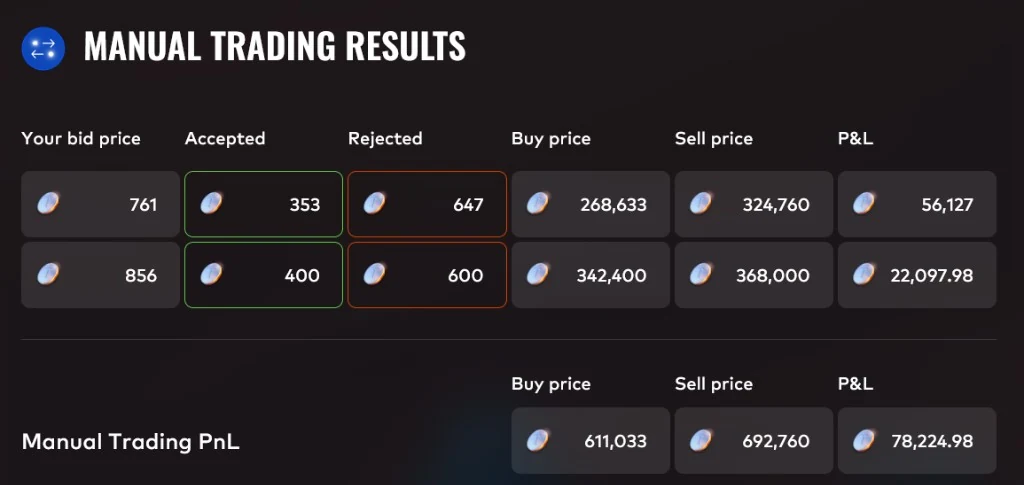
Bids of 761 and 856 filled with 353 and 400 counterparties, for 78,224.98 in total.
Round 4: Counterparty Signals
Round 4 kept the same products but revealed which counterparty was on each side of every trade. counterparty_analysis.py scored each one by how EXTRACT moved over the next 1,000 ticks after they traded. Three had a real signal: one buyer was followed by +2.24 on average, and two sellers by -1.56 and -2.14.
But following them means crossing the spread, and half the spread was about 2.50, more than any signal paid. In the 3-day backtest, turning the signals on dropped PnL from +136,001 to +117,680. Gamma scalping the vouchers, also built and tested, dropped it to +128,184, because hedging costs ate the volatility edge. Both default to off in round4.py, which carries the round 3 strategy forward.
Round 4 Manual: Pricing Exotic Options
The manual challenge was a book of options on AETHER_CRYSTAL, which follows a zero-drift GBM with 251% annualized volatility stepped 4 times a day: two- and three-week calls and puts, a chooser, a binary put, and a knock-out put. Each contract's PnL is multiplied by 3,000 and averaged over 100 simulated paths.
manual_pricer.py prices every product by Monte Carlo on IMC's exact discrete-step grid. That matters for the knock-out: the barrier is only checked at each step, so continuous-time formulas would underprice it. A greedy optimizer then ranks trades by edge times size. The book made 73,487, below the pricer's expected value: scoring uses a single batch of 100 paths, and path-dependent legs swing hard on one draw.
Round 4 manual results
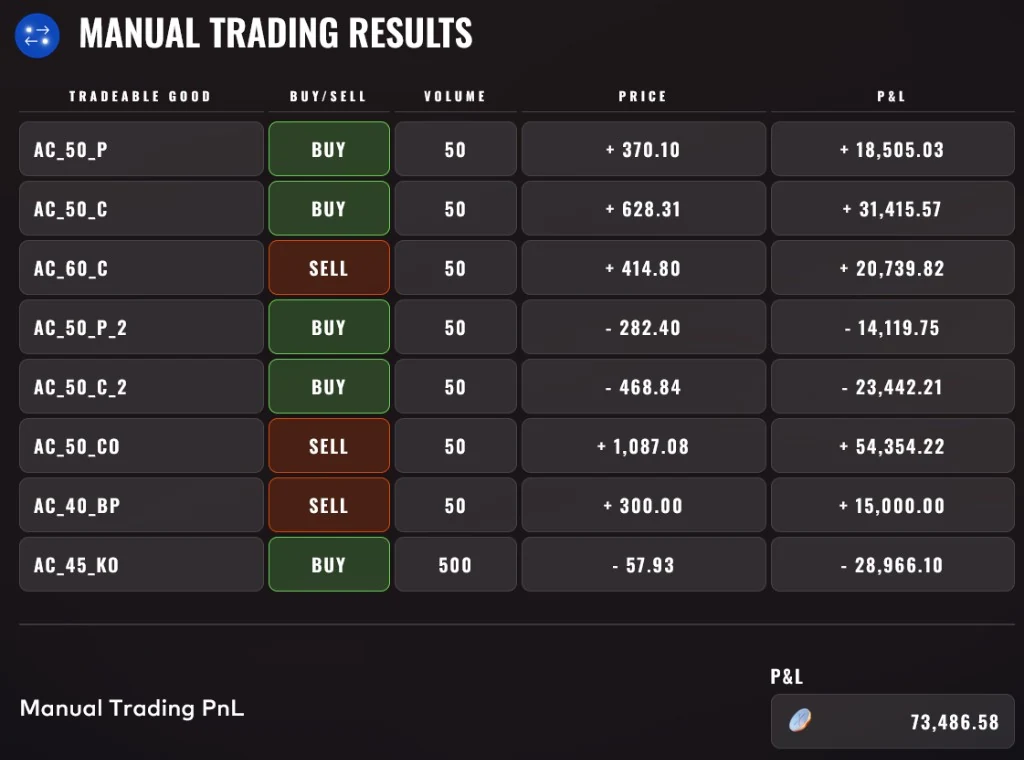
The short chooser (+54,354) and short binary put (+15,000) carried the book; the long two-week options and the long knock-out put lost on this draw of paths.
Round 5: Baskets and Overfitting
Round 5 replaced everything with 50 products in 10 categories of 5. Some categories behave like baskets: the five PEBBLES prices sum to about 50,000, so each one's fair value is 50,000 minus the other four. I built category-sum models that learn each basket's total from the opening prints and trade any leg that drifts from it, plus regression-based relative-value fits and mean-reversion trades gated on rolling autocorrelation.
A test upload with the category-sum models made +37,578 on the window IMC returned. Before trusting it, I replayed it over 273 windows of the same length: the combined models were positive only 50.5% of the time, with a worst window of -40,618. They had been fit to one sample. The final bot keeps only what held up across windows, the PEBBLES basket arbitrage and an order-book imbalance signal on three SNACKPACK products, which made +4,556 on its test window with every traded product positive.
Result and Takeaways
Final standing: 798th of about 20,000 teams overall, 211th in the USA, and 278th on the manual challenges.
What I took from it: build the model so the input most likely to be wrong stops mattering (the live smile fit made T nearly irrelevant); a real signal is only an edge if it beats the spread; trading less beat trading more; and a strategy that wins on one returned sample has to be replayed across many before it ships.